Tiny homeREVOLUTION
ary house
Concept and Spatial Organization
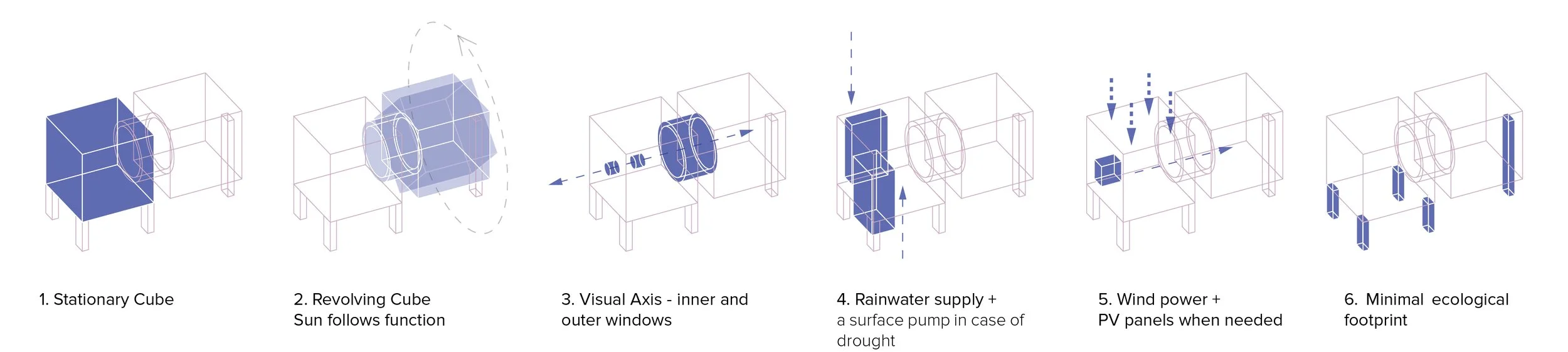
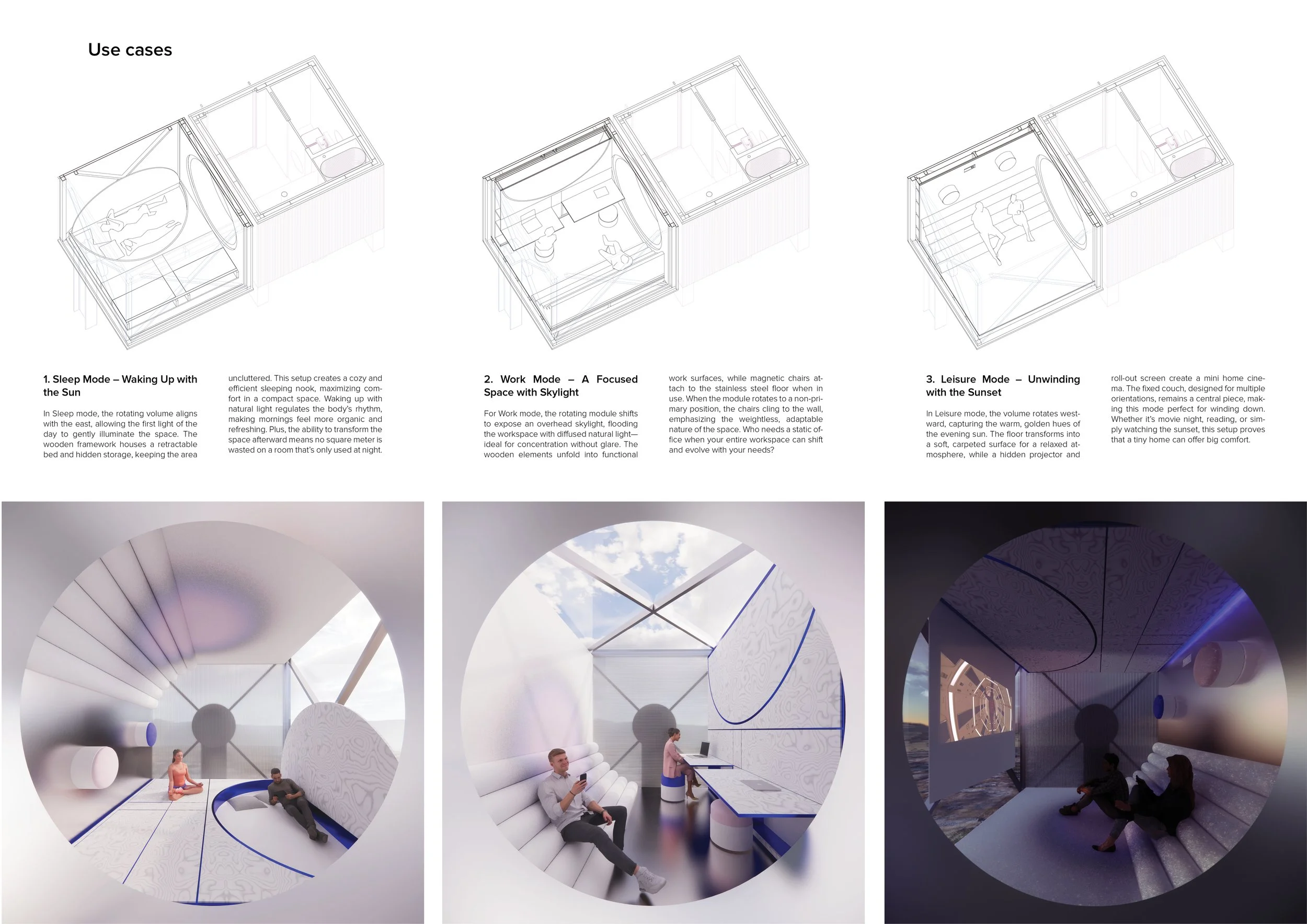
This 25m² tiny house, titled the REVOLUTIONary House, is an exploration of adaptable space, inspired by the efficiency and spatial design of the International Space Station. The design consists of two cubic volumes, one stationary and one capable of rotation, allowing for different spatial configurations throughout the day. By rotating the suspended volume, the interior transforms to support various functions—morning awakening with an east-facing window, a work mode with an overhead skylight, and an evening leisure setting oriented toward the west.
The rotating element is suspended in midair, anchored between the stationary section and a vertical steel IPE profile. This structural approach eliminates the conventional notion of a fixed floor or ceiling, reinforcing the project’s connection to the weightless, multi-directional logic of space stations. Unlike traditional tiny houses, where functions are often crammed into a single compact area, this approach allows each mode to be a fully realized, spacious environment. Instead of compromising, the rotation system ensures that each function has the space it needs to be fully functional, rather than being reduced to a hybrid, scaled-down version of itself.
Technical and Material Considerations
The Sleep mode integrates a wooden framework that conceals a retractable bed and storage compartments. When rotated into Work mode, the lower parts of this wooden structure flip out to become tables, creating a functional home office. The seating for this mode consists of magnetic chairs that adhere to the stainless steel floor when in use. However, when the module is in a non-primary position, the chairs attach to the walls, emphasizing the adaptability of the space. Each mode is further reinforced by its material palette—the warmth of wood enhances the sleep environment, the stainless steel flooring in Work mode gives a sense of precision and focus, and the soft carpet in Leisure mode fosters relaxation and comfort.
The rotation mechanism operates through a system of large bearing wheels and rotors, controlled manually via a lever. This mechanical interaction fosters a tangible, hands-on relationship between the user and their living environment, emphasizing human agency in spatial adaptation.
The stationary module houses essential utilities, including the kitchen, bathroom, and off-grid technical core. The kitchen is compact yet efficient, featuring a wooden stove and a suspended refrigerator. The bathroom is equipped with a composting toilet. Water supply is managed through a rainwater collection system, supplemented by a surface pump in case of drought. Filtration ensures potable water for the kitchen and bathroom basins. All wastewater from the shower and sinks is directed into greywater tanks positioned beneath the stationary core.
Energy is sourced from renewable resources, primarily wind power—an optimal choice for the Icelandic context. However, the system allows for integration with photovoltaic panels if needed.Designed on stilts, the house has no basement, minimizing its ecological footprint and allowing placement in environmentally protected areas. This elevated structure further reinforces its adaptability, making it possible to install the structure on diverse terrains without significant ground disturbance.